

Alumna D’Souza returns to challenge dentistry to translate discovery into impact
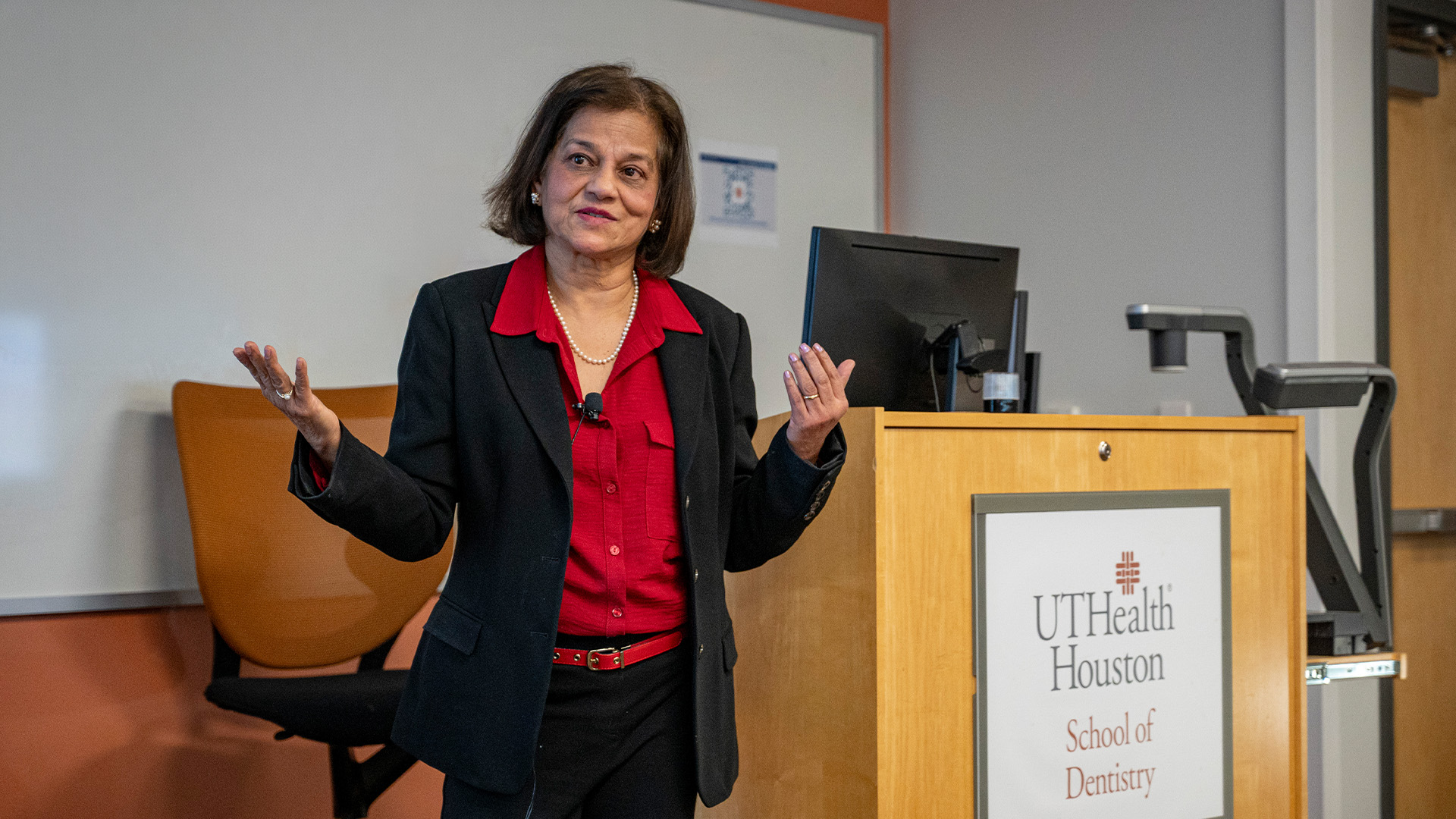
Alumna Rena N. D’Souza, DDS, MS, PhD, delivered a guest lecture, titled “Realizing the Promise of Science: Translate We Must!,” to faculty, students, and residents. Photo by Kyle Rogers.
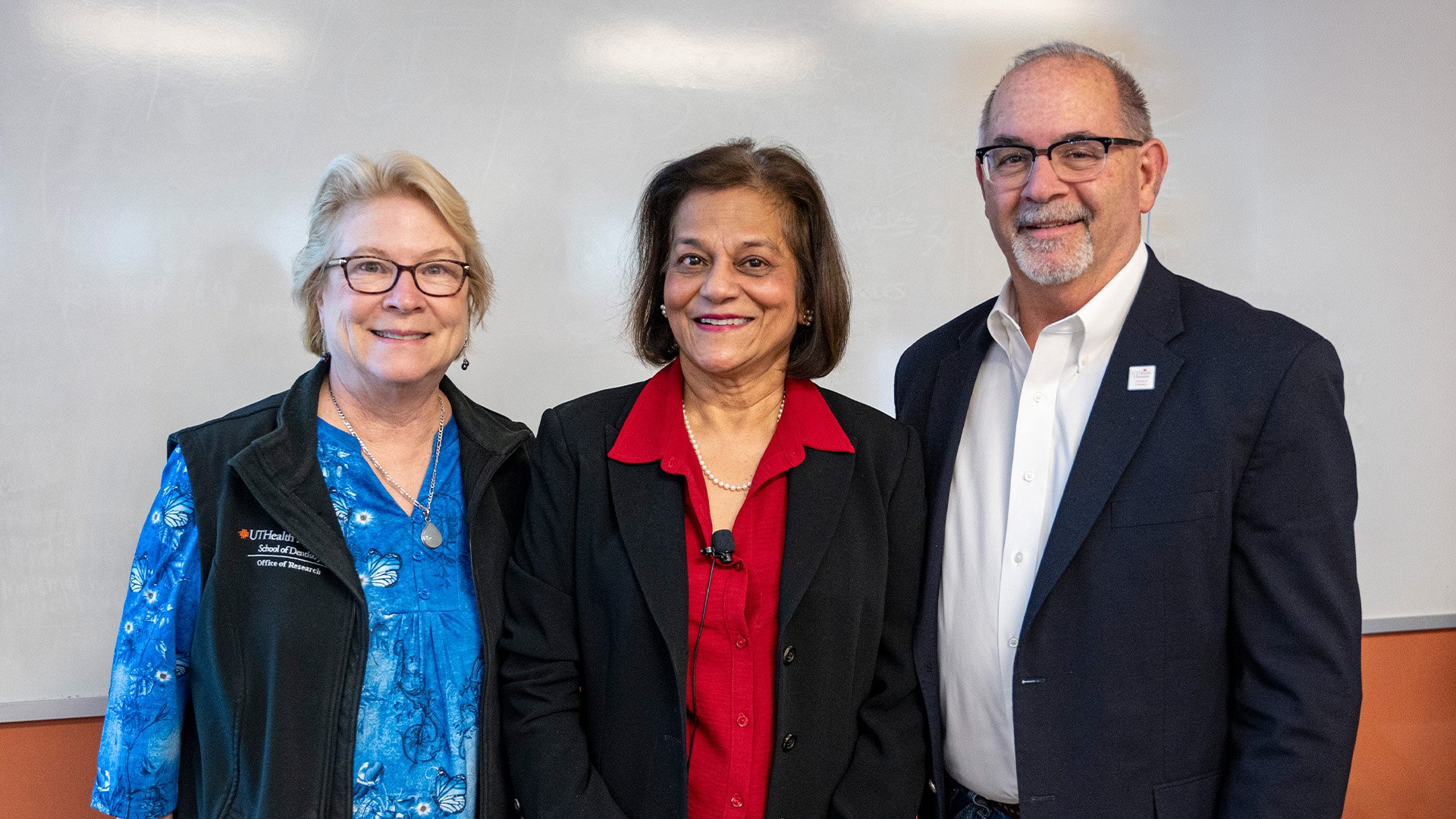
From left: Mary C. "Cindy" Farach-Carson, PhD; Rena N. D’Souza, DDS, MS, PhD; and John A. Valenza, DDS. Photo by Kyle Rogers.
More than four decades after earning her dental degree, Rena N. D’Souza, DDS, MS, PhD, returned to UTHealth Houston School of Dentistry on Jan. 16 with a message shaped by a lifetime at the forefront of science, policy, and academic leadership: discovery alone is not enough.
Delivering a guest lecture titled “Realizing the Promise of Science: Translate We Must!” to faculty, students, and residents, the 1985 alumna urged the next generation of oral health professionals to ensure research reaches patients and communities. In 2022, she was named the inaugural recipient of the school’s Alumni Lifetime Achievement Award.
D’Souza, who recently concluded her tenure as director of the National Institute of Dental and Craniofacial Research, framed her talk around a central challenge facing modern health care: bridging the persistent gap between what science knows and what clinicians do.
“We have not been able to translate what we actually know into what we do as well as we should,” she said.
Dentistry’s legacy — and its responsibility
Drawing on history, D’Souza emphasized that dentistry has long been a driver of major biomedical breakthroughs, from anesthesia to imaging technologies. That legacy, she argued, carries an obligation to lead again — by demonstrating dentistry’s central role in overall health.
“Oral health is integral for systemic health,” she said, noting that many major diseases share risk factors that pass through the mouth.
She highlighted the extraordinary complexity of the craniofacial system and the global burden of oral diseases as reasons the profession must embrace interdisciplinary science, prevention, and public health leadership.
From silos to collaboration
A recurring theme of the lecture was the need to break down traditional boundaries between research, education, and clinical care.
In the past, she said, professionals could remain within narrow specialties. That model no longer works.
“Those days are gone,” D’Souza said, describing a future in which clinicians and scientists must work together across disciplines.
She described translation not as a single step, but as a continuous cycle connecting laboratory discovery, patient care, community health, and back again.
“To be translational means that you have to be looking at that circle and knowing that you belong,” she said. “Everyone has a role.”
Communication, she stressed, is the missing link.
“Translation means more talking,” she said, calling for stronger collaboration among clinicians, researchers, policymakers, and communities.
A rapidly changing research landscape
D’Souza also addressed shifts in federal funding priorities, emerging technologies, and new expectations for accountability in science.
She pointed to artificial intelligence, data science, and “whole-person health” approaches as forces reshaping how research is conducted and applied.
“Data science is really the new oil,” she said, emphasizing the need for interoperable health records and shared information to accelerate discovery.
Inspiring the next generation
Throughout her talk, D’Souza returned to the importance of mentorship, curiosity, and purpose — particularly for students and trainees.
She expressed concern that some learners enter dental school eager to engage in research but leave without pursuing scholarly careers, a gap she believes must be addressed to sustain innovation.
“You are unique. You have innate talents,” she said, encouraging trainees to identify their purpose and remain engaged in shaping the future of the profession.
A vision rooted in prevention and equity
Looking ahead, D’Souza described a future in which oral health plays a central role in improving overall well-being, especially for vulnerable populations.
“I dream of a world where every child can lead a life that is free of stigma and poverty,” she said.
Achieving that vision, she argued, will require integrating genetic, environmental, and behavioral factors — and shifting health systems toward prevention rather than intervention.
A homecoming with purpose
For the School of Dentistry community, D’Souza’s visit was both a reunion and a call to action. By sharing insights from national leadership and global experience, she challenged the institution that launched her career to help shape dentistry’s next era.
“In the midst of every crisis, there are opportunities,” she said, quoting Albert Einstein as she urged the audience to anticipate the future rather than react to it.
Her closing message echoed the lecture’s title: the promise of science will be realized only if discoveries are translated into real improvements in health.