

Farach-Carson honored as IADR distinguished scientist in salivary research
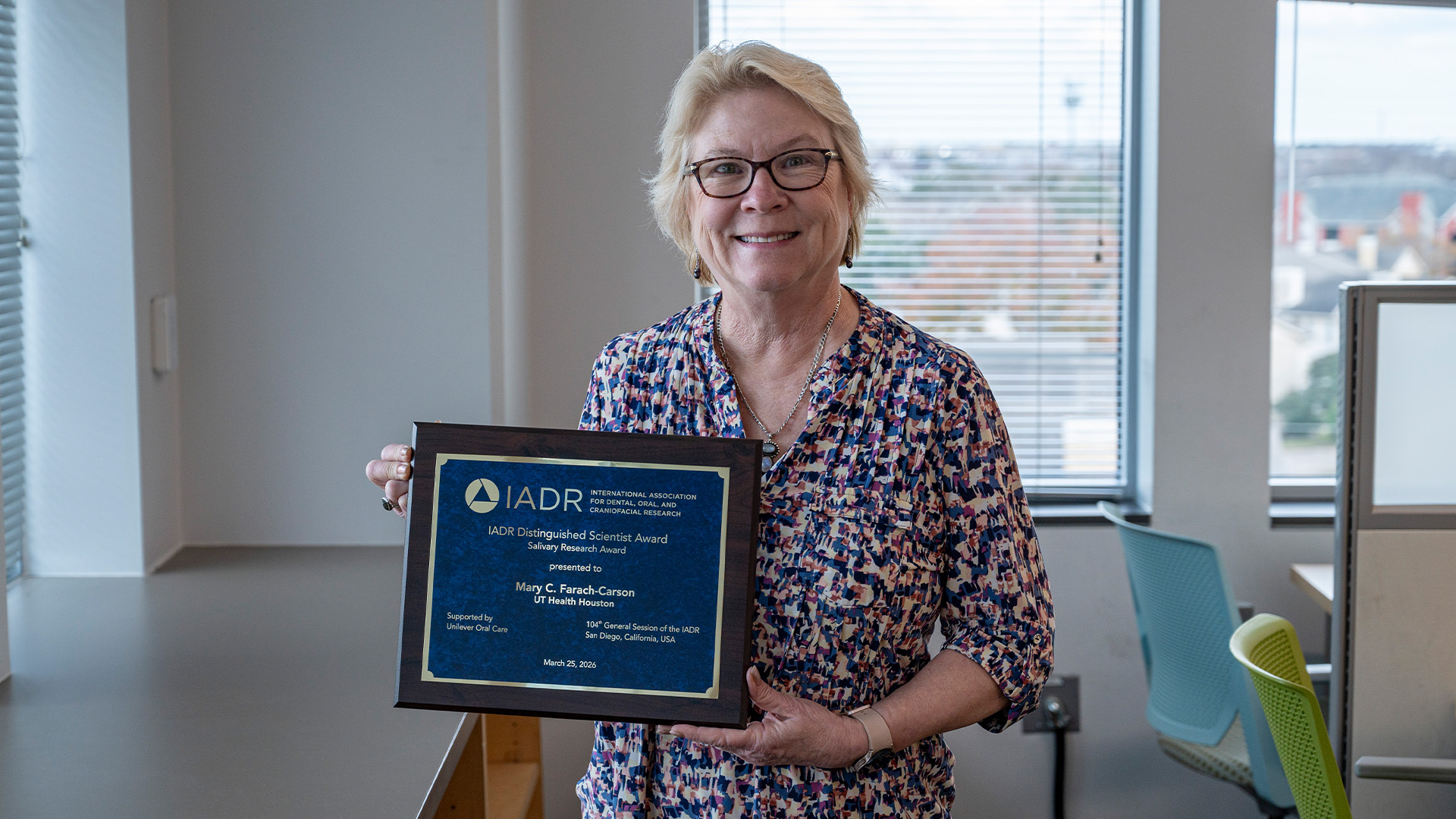
Professor Mary (Cindy) Farach-Carson, PhD, associate dean for research at UTHealth Houston School of Dentistry, has been named the 2026 recipient of the IADR Distinguished Scientist Award in Salivary Research. Photo by Dylan Allen.
Mary (Cindy) Farach-Carson, PhD, associate dean for research and professor in the Department of Diagnostic and Biomedical Sciences at UTHealth Houston School of Dentistry, has been named the 2026 recipient of the International Association for Dental, Oral, and Craniofacial Research Distinguished Scientist Award in Salivary Research.
The IADR Distinguished Scientist Award is among the association’s most prestigious honors, recognizing outstanding research achievements and leadership across oral, dental, and craniofacial science. Farach-Carson was recognized for her innovative contributions to the understanding of salivary gland biology and function.
Supported by Unilever Oral Care, the salivary research honor recognizes outstanding and innovative achievements that advance understanding of salivary gland structure, secretion, and function, or salivary composition and function. Recipients are selected through a competitive nomination process led by committees composed of previous award winners.
Farach-Carson was recognized as one of 17 honorees receiving the IADR Distinguished Scientist Award during the opening ceremonies of the 104th IADR General Session and Exhibition in San Diego. The award included a $3,500 monetary prize and a commemorative plaque.
Farach-Carson, a Galveston native, is an active researcher with a federally and industry-funded laboratory focused on tissue engineering, extracellular matrix, and cancer biology. Her research integrates extracellular matrix biology with salivary tissue engineering, cancer metastasis, and musculoskeletal biology, advancing regenerative therapies and translational approaches to salivary gland dysfunction.
She is a pioneer in the use of complex three-dimensional systems for cell and microtissue culture of both normal and cancerous tissues. Her team is also exploring tissue regeneration techniques to restore salivary glands damaged by radiation treatment for head and neck cancer, which can result in severe xerostomia, or dry mouth.
“Winning this award is an honor not only for me, but for the outstanding trainees and colleagues whose creativity and dedication made this challenging work possible,” Farach-Carson said. “Their contributions helped transform an ambitious idea into meaningful progress. We are now focused on translating our advances in salivary gland tissue engineering toward first-in-human studies, an important next step toward bringing relief to cancer survivors experiencing xerostomia.”
Author of more than 250 publications and co-editor of the seven-volume series Topics in Bone Biology, Farach-Carson frequently serves as a reviewer for grant applications and scientific journals. She has mentored dozens of graduate students and postdoctoral fellows and hosted hundreds of trainees for research rotations.
Farach-Carson currently serves as associate dean for research at the School of Dentistry, where she supports research infrastructure, fosters interdisciplinary collaboration, and advances translational science initiatives across the dental school, UTHealth Houston, and the Texas Medical Center.
Farach-Carson earned a bachelor’s degree in biology from the University of South Carolina in 1978 and a biochemistry doctorate from Virginia Commonwealth University in 1982. She completed postdoctoral training at Johns Hopkins University and The University of Texas MD Anderson Cancer Center.
After 11 years on the UTHealth Houston School of Dentistry faculty, Farach-Carson joined the University of Delaware as a professor of biological sciences and founding director of the Center for Translational Cancer Research. She later provided scientific leadership for the BioScience Research Collaborative at Rice University and served as a strategic advisor for the Texas Medical Center before returning to the dental school in 2016.
The IADR represents a global network of scientists advancing research to improve oral health worldwide. Founded in 1920, the association supports researchers and promotes the advancement of dental, oral, and craniofacial science.