

Full circle impact: National research leader gives back to the school that shaped her
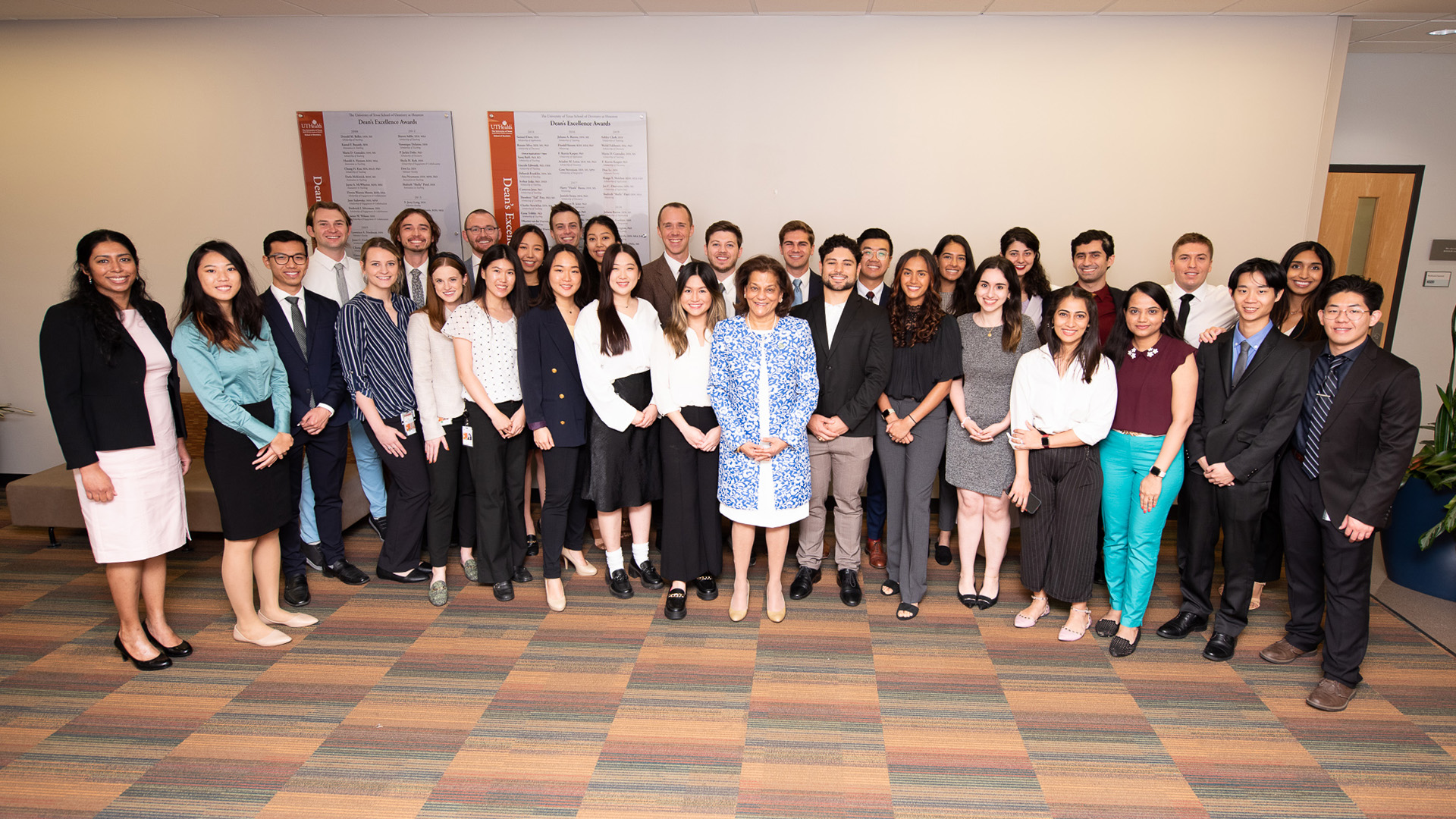
Alumna Rena D’Souza, DDS, MS, PhD, poses with students before delivering the 2022 William T. Butler Distinguished Lecturer at UTHealth Houston School of Dentistry. Photo by Brian Schnupp.

Rena D’Souza, DDS ’85, PhD ’87 (right), holds her 2022 UTHealth Houston School of Dentistry Alumni Lifetime Achievement Award, presented by Dean John A. Valenza, DDS ’81. Photo by Brian Schnupp.
After delivering a lecture on the genes that drive tooth development to orthodontic residents, Rena D’Souza, DDS ‘85, PhD ‘87—then an Associate Professor at UTHealth Houston School of Dentistry—posed a simple offer: Consult with her if they encountered a perplexing case.
One resident, Dr. Monica Goldenberg, soon reached out after seeing a young patient missing teeth. Instead of falling out, these teeth had never existed. Intrigued, D’Souza collaborated with colleagues across the Texas Medical Center and traced the condition through the patient’s family history. She identified it as tooth agenesis, an inherited disorder in which certain teeth fail to grow, and linked it to a gene called PAX9. The discovery advanced scientific understanding of how teeth form and why they sometimes don’t.
“I always wanted to find the answers to what I saw when treating patients,” she says.
That instinct to pursue difficult questions has guided D’Souza through a distinguished career spanning clinical dentistry and research at institutions across the country. She ultimately rose to become the Director of the National Institute of Dental and Craniofacial Research (NIDCR), the federal government's lead agency for scientific research on dental, oral, and craniofacial health.
“It’s been quite a journey, and I would absolutely travel this path again,” she says.
D’Souza earned a dental degree in India before coming to Houston with her fiancé and later spouse, Richard D’Souza, who worked in the oil and gas industry. She chose UTHealth Houston School of Dentistry to earn a DDS while pursuing a PhD.
“I realized during the program that I had a deep curiosity and could not take anything at face value,” she says. “There were many questions unanswered about what we do in dentistry, and I wanted to find the answers on a molecular level.”
After graduating with her DDS in 1985, she completed a PhD in Biomedical Sciences from The University of Texas MD Anderson Cancer Center UTHealth Houston Graduate School of Biomedical Sciences in 1987. That training set the foundation for a lifelong focus on craniofacial development and genetics, studying normal and abnormal tooth and palate formation.
D’Souza joined the faculty at the School of Dentistry in 2001 and discovered a passion for teaching, beginning with dental hygiene students.
“I learned how to communicate difficult concepts in a clear way, and I loved interacting with the students,” she says. “They taught me as much as I taught them.”
Mentoring others became central to her career, and she would go on to serve as Chairperson of the Department of Biomedical Sciences at the Texas A&M (formerly Baylor) School of Dentistry and then the inaugural dean of the University of Utah School of Dentistry.
“With every success, it’s just as equally uplifting to see a mentee succeed,” she says.
That commitment to advancing both science and people is what ultimately inspired D’Souza and her husband to give back. They recently established the Rena N. D’Souza, DDS, MS, PhD, Research Endowment in Health Promotion at the School of Dentistry’s Center for Health Promotion—an initiative that reflects her belief that oral health is inseparable from overall health. This passion was shaped during her career at NIDCR.
The center, a first-of-its-kind clinic on the dental school’s first floor, serves as a hub where dentistry, medicine, and behavioral health come together to prevent disease and promote the oral and overall health of patients. The endowment will support research that advances this integrated approach.
“Everything seems to go through the mouth, which serves as a portal of entry to the rest of the body,” she says, pointing to links between oral health and broader health conditions.
D’Souza values her ongoing connection with the School of Dentistry and returned to campus in January 2026 to deliver a guest lecture. As she looks back on her career—the achievements, research breakthroughs, and prestigious leadership roles—D’Souza views success through a different lens.
“I look at the lives I’ve impacted,” she says. “What will continue to drive me and Richard moving forward is the same goal we have always had: Just do good and make a difference.”