

School of Dentistry research earns national recognition from AAOMS
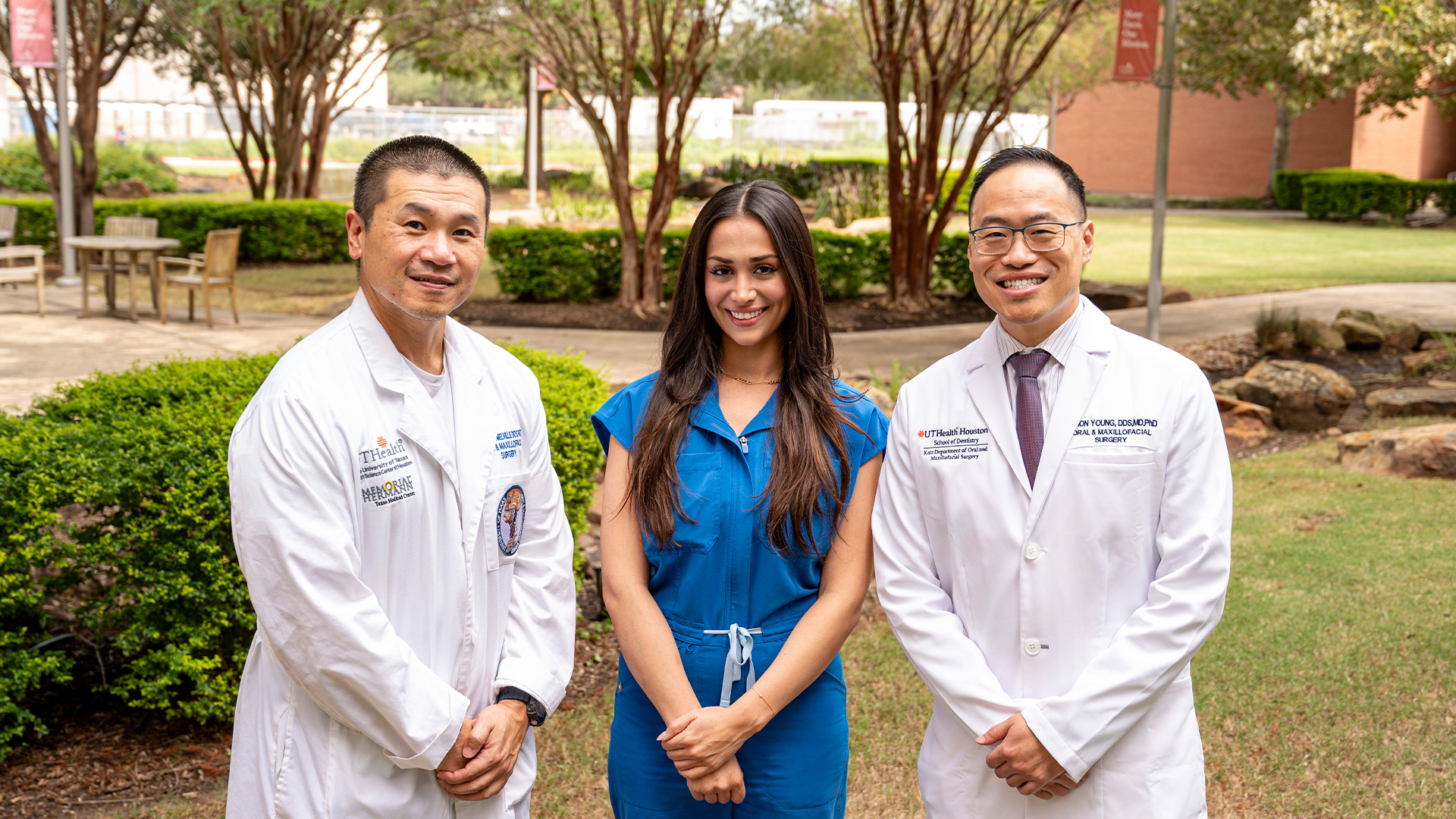
From left, James C. Melville, DDS; dental student Fatemeh Ebrahimi; and Simon W. Young, DDS, MD, PhD, whose research accomplishments were recognized at the 2026 AAOMS Annual Meeting. Photo by Kyle Rogers.
Research to prevent surgical errors, advance regenerative medicine, and support the next generation of oral and maxillofacial surgeons earned national recognition for members of the UTHealth Houston School of Dentistry community at the 108th American Association of Oral and Maxillofacial Surgeons Annual Meeting, Scientific Sessions, and Exhibition in Seattle.
Professor Simon W. Young, DDS, MD, PhD, chair of the Bernard and Gloria Pepper Katz Department of Oral and Maxillofacial Surgery, received the 2026 Stephen B. Milam Award for a research proposal exploring how artificial intelligence could help prevent wrong-tooth extractions.
The recognition extended to the next generation of researchers, as third-year dental student Fatemeh Ebrahimi received the Osteo Science Foundation Dental Student Research Mentorship Award and presented research developed with faculty mentor James C. Melville, DDS, on tissue-engineered reconstruction of the mandibular condyle.
The meeting also recognized the research legacy of Mark E. K. Wong, DDS, the department’s longtime former chair and professor, who received the 2026 OMS Foundation Research Recognition Award before his passing on Sept. 4. The foundation established a fellowship in his honor to support future surgeon-scientists.
The meeting was held Sept. 30-Oct. 3.
AI research aims to prevent surgical errors
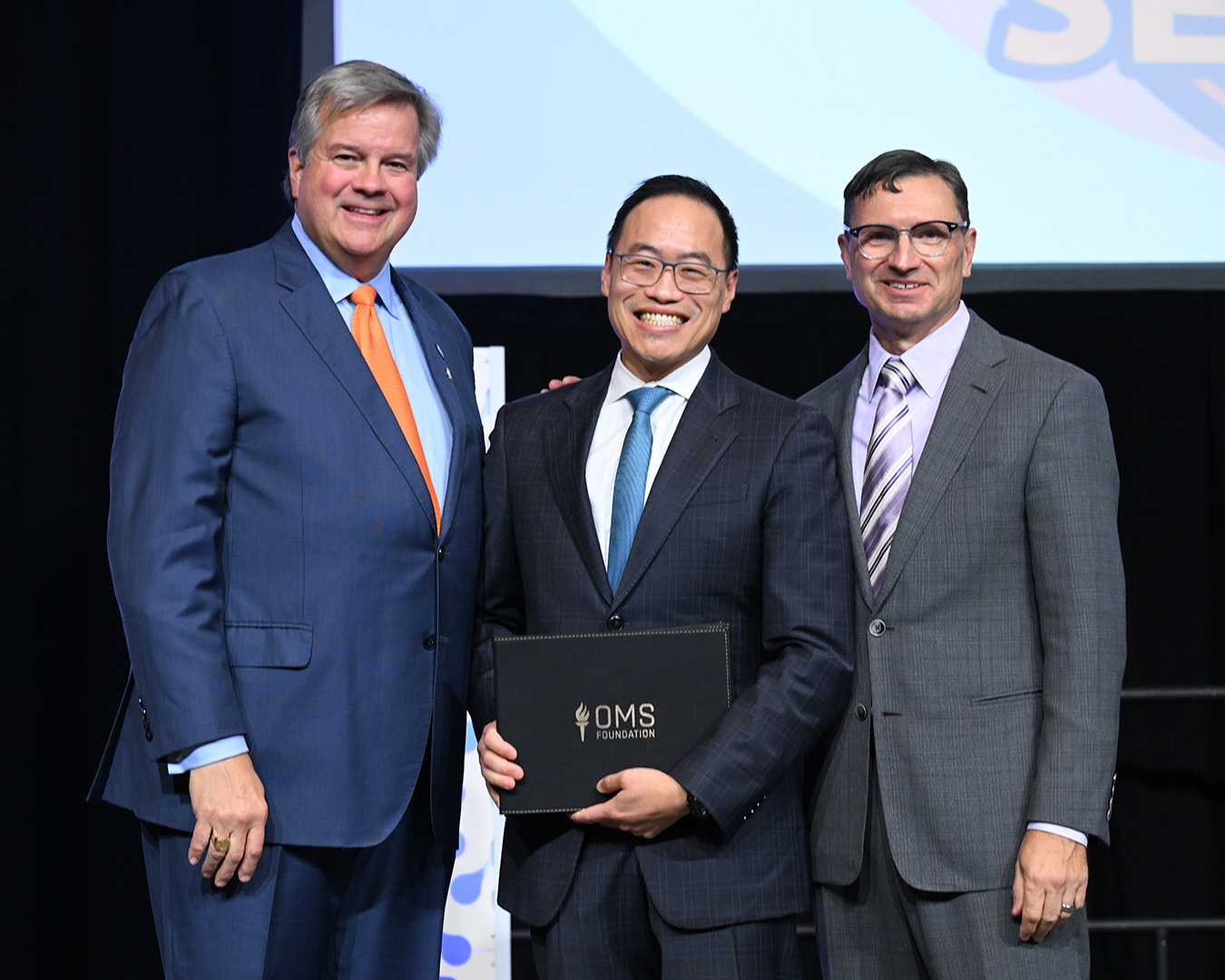
Young’s Stephen B. Milam Award recognizes the highest-scoring research grant proposal in the OMS Foundation’s annual review process. His project, titled “Artificial Intelligence (AI)-Powered Early Warning System to Prevent Wrong-Tooth Extraction (WTE) in Oral & Maxillofacial Surgery,” aims to add a layer of protection against a rare but potentially devastating patient-safety event.
Known as PREDICT-WTE, the project grew out of a School of Dentistry leadership retreat where a discussion about wrong-tooth extraction prompted a question: Could AI help identify high-risk cases before an irreversible error occurs?
The project brings together clinicians, patient-safety researchers, informatics experts, and AI researchers from UTHealth Houston’s School of Dentistry and the D. Bradley McWilliams School of Biomedical Informatics. Sayali Tungare, BDS, MPH, PhD, serves as principal investigator, coordinating the clinical and research teams and overseeing data collection, annotation quality, and clinical validation. Muhammad Walji, PhD, contributes dental patient-safety and clinical informatics expertise as a consultant, advising on case annotation, risk categorization, and translation into clinical practice.
“Wrong-tooth extraction is a rare but devastating and preventable event,” Young said. “What makes this project exciting to me as a surgeon is that we are taking a very practical problem from clinical care and bringing together clinicians, patient-safety researchers, informatics experts, and artificial intelligence researchers to develop a new way of preventing it.”
The team plans to develop and validate an AI model that combines dental images with electronic health record information. The proposed system would look for warning signs, such as unusual anatomy or inconsistencies among referrals, treatment plans, consent forms, and other clinical documentation.
Rather than simply assigning a risk score, the system would aim to explain why a case may need additional review and prompt the clinical team to take action. That could include reconciling conflicting documentation, reviewing or obtaining additional imaging, or conducting a focused time-out before proceeding.
Because wrong-tooth extractions are uncommon, researchers will supplement an annotated dataset of actual cases and matched controls with clinically realistic synthetic cases. They will then develop and validate the model.
The project has also expanded through the UT REAL Health AI Initiative, bringing in colleagues at UT Health San Antonio School of Dentistry. The collaboration will support a shared dataset across the two institutions and help researchers assess whether the approach can be applied in different clinical settings.
If successful, the approach could eventually help prevent other wrong-site or wrong-procedure events in dentistry.
Student research advances regenerative medicine
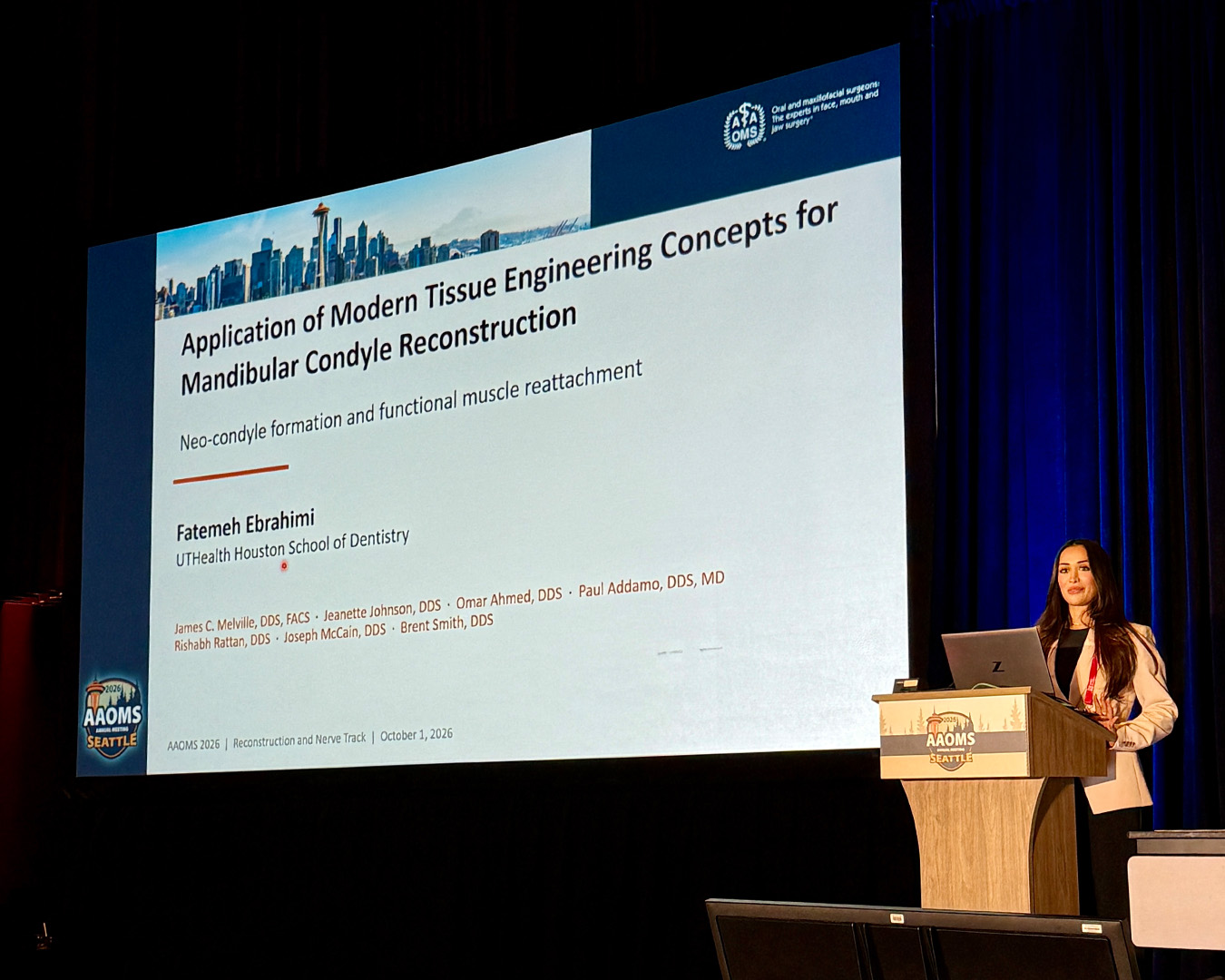
Ebrahimi’s award supported her research into a tissue-engineering approach to reconstructing the mandibular condyle, the rounded part of the lower jaw that meets the skull at the temporomandibular joint.
The Osteo Science Foundation Dental Student Research Mentorship Award supports dental students conducting regenerative medicine research with an oral and maxillofacial surgery mentor. Ebrahimi was selected through an application and interview process, with Melville serving as her mentor. The $5,000 award covered research-related expenses, publication costs, and travel to present the findings at the meeting.
Ebrahimi presented the abstract “Application of Modern Tissue Engineering Concepts for the Reconstruction of Mandibular Condyles and Muscle Reattachment for Full Function,” which was also published in the Journal of Oral and Maxillofacial Surgery.
The retrospective case series examined five patients who underwent mandibular reconstruction involving removal of the condyle. The approach combined bone marrow aspirate concentrate, recombinant human bone morphogenetic protein-2 delivered through a collagen carrier, and an allogeneic fibula bone scaffold.
Four patients showed progressive bone regeneration and formation of a new condylar structure. Magnetic resonance imaging also showed reattachment of the lateral pterygoid muscle to the reconstructed condyle. One patient experienced postoperative soft-tissue dehiscence, but the graft remained intact and structurally stable at the one-year follow-up.
The findings suggest tissue engineering may offer a way to restore mandibular anatomy and function and could eventually reduce reliance on traditional bone grafts and prosthetic joints. Further research is needed to assess the approach’s effectiveness.
Ebrahimi said research offers an opportunity to explore questions beyond the classroom and learn from clinicians working to improve patient care.
“When I learned about Dr. Melville’s work in tissue engineering and mandibular reconstruction, I was immediately drawn to the opportunity to learn from someone at the forefront of advancing reconstructive techniques in oral and maxillofacial surgery,” she said. “I was fascinated by how regenerative medicine could significantly improve patients’ quality of life.”
Presenting at the meeting allowed her to share the findings, discuss the work with other researchers, and learn from experienced surgeons. She also credited Melville and Young with shaping her professional goals through their commitment to teaching and mentorship.
“Their mentorship has strengthened my passion for oral and maxillofacial surgery and shaped the kind of surgeon and mentor I hope to become,” she said.
Wong’s research legacy continues
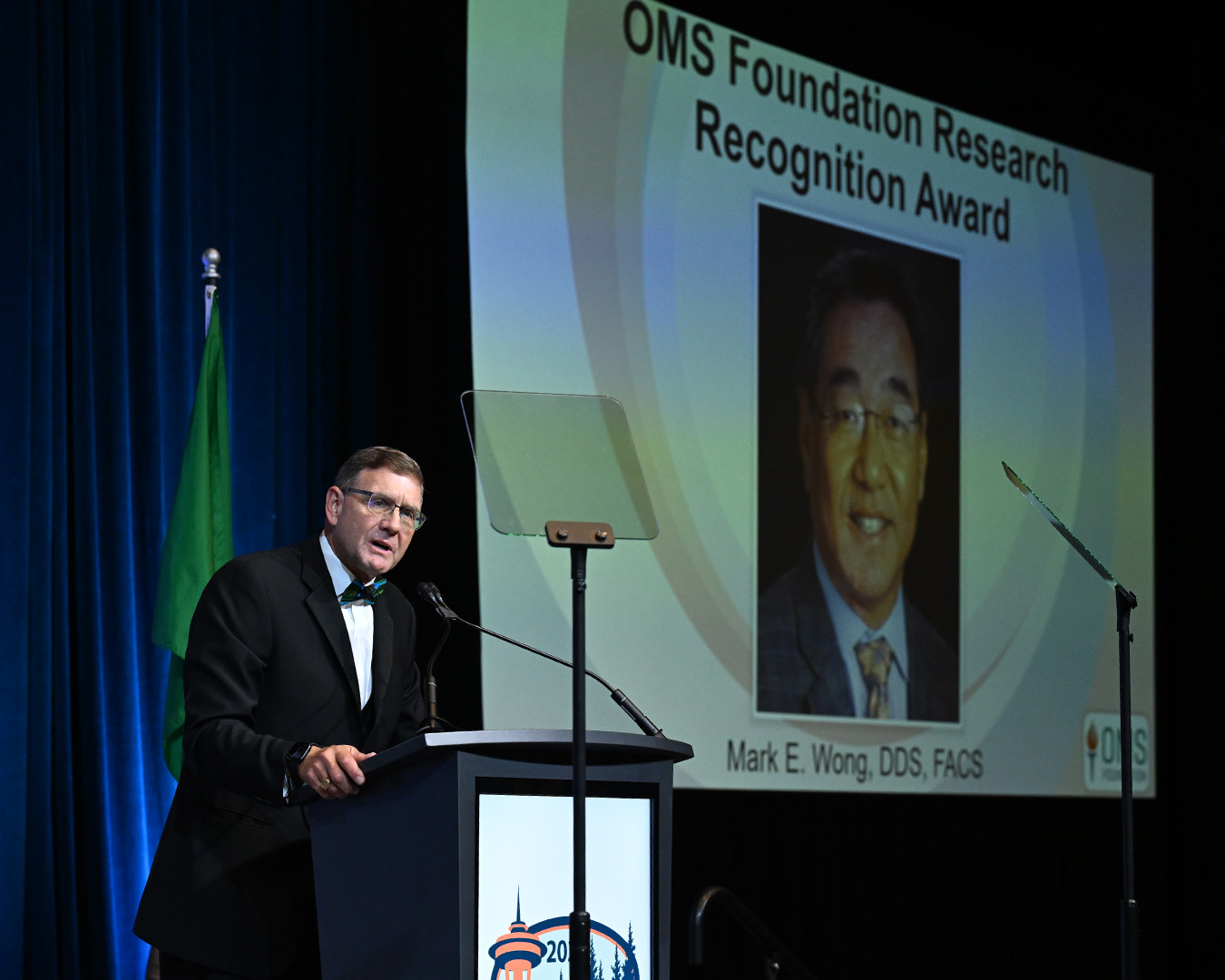
During the meeting’s opening ceremony, Steve Nelson, DDS, speaker of the AAOMS House of Delegates, announced Wong as the recipient of the 2026 OMS Foundation Research Recognition Award, noting that Young had personally presented the award to Wong in Houston before he passed away.
Wong’s research focused on reconstructive surgery, bone tissue engineering, and the biomechanics and regeneration of the temporomandibular joint. During nearly four decades at the School of Dentistry, he trained and mentored generations of oral and maxillofacial surgeons.
The OMS Foundation Mark E. Wong Research Fellowship will support advanced, mentored research training for surgeon-scientists, extending Wong’s influence on the specialty through research and mentorship.