

Teaching and Learning Day explores AI’s role in dental education
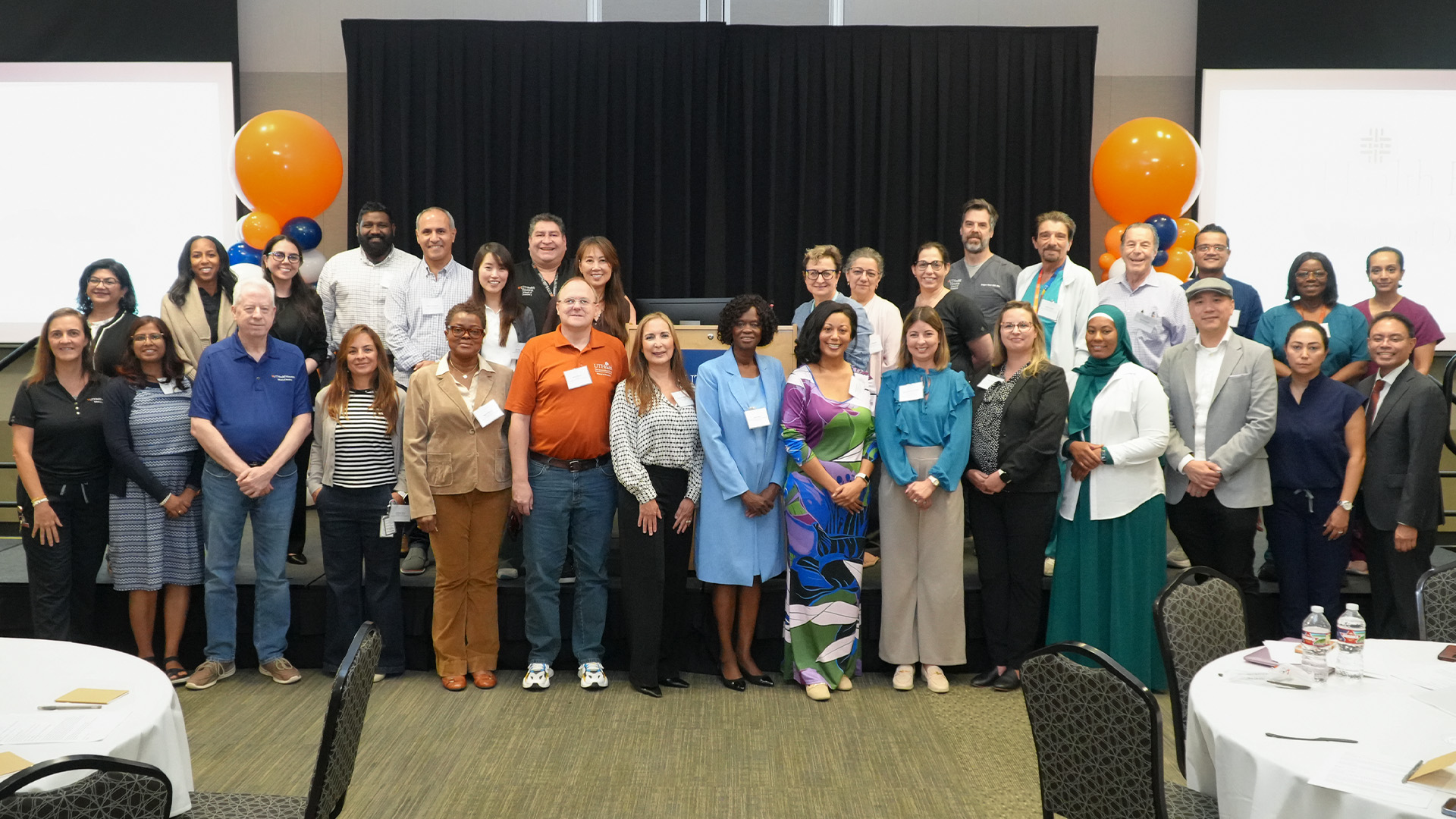
Faculty and speakers gathered for a group photo, celebrating a day of collaboration and exploration into AI in dental education. Photo by Jackson Calderon/McWilliams School of Biomedical Informatics at UTHealth Houston.
As artificial intelligence continues to reshape education, faculty explored how it can be thoughtfully integrated during the inaugural Teaching and Learning Day at UTHealth Houston School of Dentistry.
Hosted by the Center for Teaching and Learning on July 31 in the Cooley University Life Center, the event centered on the theme, “AI in Dental Education: Transforming Teaching and Learning,” and featured presentations from leaders in dental informatics, health care education, and instructional innovation. Faculty examined how emerging technologies can enhance instruction, strengthen student learning, and prepare future oral health professionals for an evolving clinical landscape.
“Teaching is the foundation upon which everything else is built,” said Professor Harold Henson, RDH, PhD, director for the Center for Teaching and Learning, during opening remarks. “Every outstanding teacher, clinician, researcher, and leader begins with a great teacher.”
The keynote presentation, “Beyond the Hype: AI in Oral Health Education,” was delivered by Alexander Lee, DMD, professor and assistant dean for dental informatics at Western University of Health Sciences College of Dental Medicine in Pomona, California.
Rather than focusing solely on AI’s future potential, Lee demonstrated ways faculty can already begin using it. He shared examples of using AI to develop formative assessments, analyze feedback, identify curricular gaps, and streamline educational tasks, allowing educators to spend more time on teaching and mentoring while maintaining sound educational principles and professional judgment.
Lee challenged attendees to view AI not as a replacement for educators or clinicians, but as a tool that must be understood, evaluated, and applied responsibly.
“Oral health professionals have the golden opportunity to still dictate the conversation,” Lee said. “You each personally hold a piece of the key to a better tomorrow where AI is harmonized with our profession.”
Mary Sizemore, PhD, senior director of education practice and workforce advancement in the Education and Training Division at The University of Texas MD Anderson Cancer Center, shifted the discussion from AI tools to instructional strategy with sessions focused on enhancing student engagement and rethinking assessment in an AI-enabled learning environment.
Sizemore encouraged faculty members to approach AI with intention, emphasizing that technology should enhance, not replace, meaningful learning experiences. She shared practical strategies for incorporating AI into classroom and clinical instruction, designing learning activities that foster active learning and student engagement, and creating authentic assessments that measure clinical reasoning, communication, and critical thinking while keeping learners, ethics, and human-centered teaching at the forefront.
The afternoon concluded with a poster session highlighting educational innovations and scholarship from members of the School of Dentistry community, followed by recognition of poster presenters. During closing remarks, Associate Dean for Professional Development and Faculty Affairs Lisa D. Cain, PhD, thanked participants and noted that organizers are already planning a second Teaching and Learning Day, building on this year’s focus on artificial intelligence and educational transformation.
