

Tokede awarded $3.5 million grant to support AI-assisted dental research platform
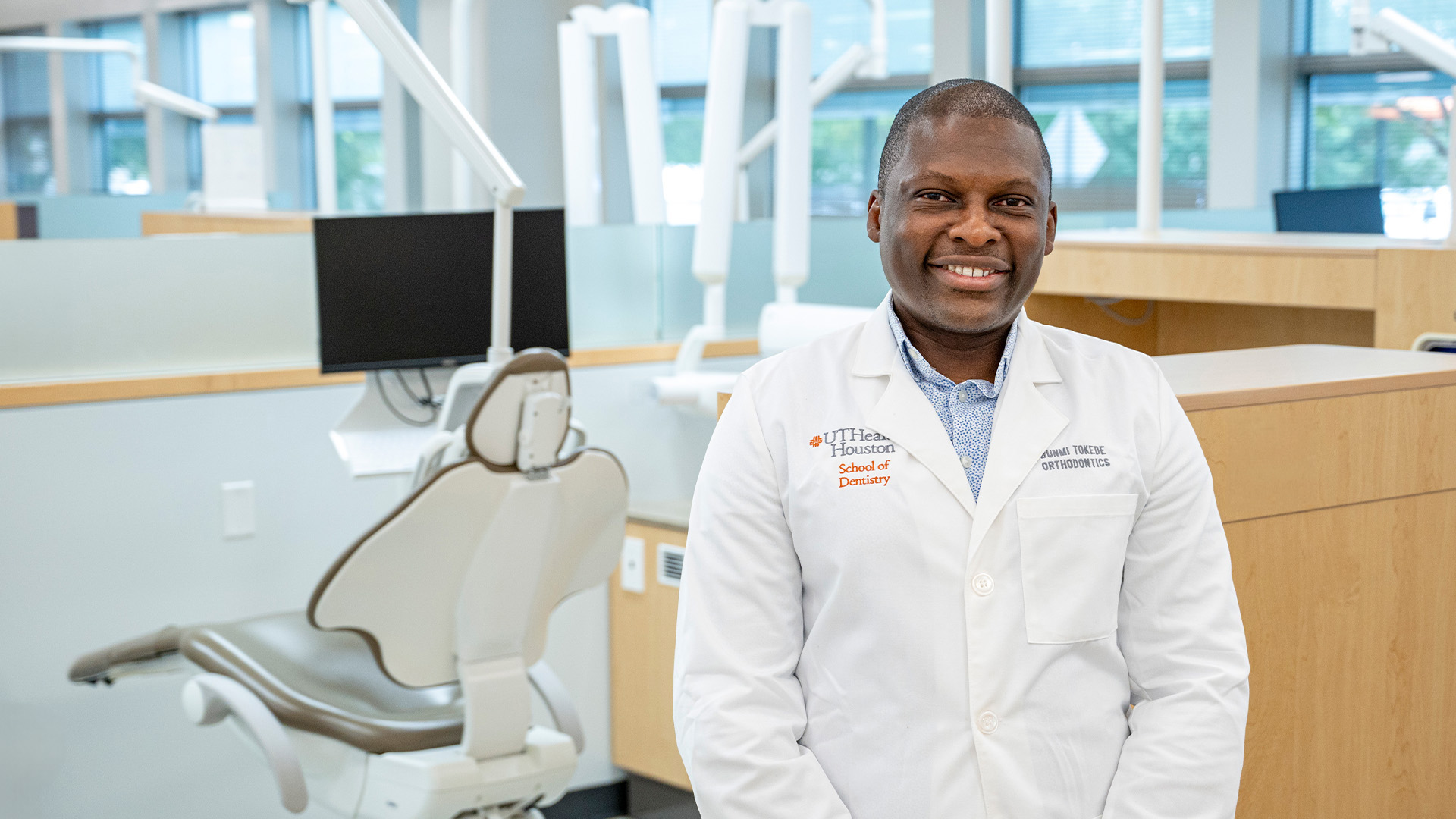
Oluwabunmi “Bunmi” Tokede, BDS, MPH, DMSc, has been awarded a five-year, $3.54 million National Institute of Dental and Craniofacial Research grant to develop OpenMouth, an AI-powered platform for large-scale dental research. Photo by Kyle Rogers.
Oluwabunmi “Bunmi” Tokede, BDS, MPH, DMSc, associate professor at UTHealth Houston School of Dentistry, has been awarded a five-year, $3.54 million R01 grant from the National Institute of Dental and Craniofacial Research, part of the National Institutes of Health, to develop OpenMouth, an artificial intelligence-powered research platform designed to make large-scale dental research more accessible to investigators across the profession.
The project, “OpenMouth: Leveraging AI to Enhance FAIRness in Dental Clinical Research,” aims to address long-standing barriers that have limited dental research compared with other areas of healthcare.
Tokede said the project was inspired by a gap in the research infrastructure available to dentistry.
“Over the past decade, medicine has been transformed by large, shared collections of de-identified data from real-world patient care that qualified researchers can study,” he said. “Dentistry never received comparable infrastructure.”
Without that infrastructure, dental researchers have largely relied on claims data or smaller collections of clinical records from individual institutions, limiting the questions they can ask and making it difficult to determine whether findings apply across broader patient populations. Most dental training also does not include advanced database programming or large-scale health data analysis, creating a technical barrier for investigators without dedicated informatics support.
OpenMouth aims to address those challenges by creating a secure, shared research environment that enables investigators to study dental data at scale. Building on the multi-institutional BigMouth dental data repository, the platform will incorporate artificial intelligence tools that help researchers move from a research question to a study.
“Researchers will be able to ask questions in plain language, the way one might ask a colleague, and receive assistance identifying patient populations, building study queries, and conducting analyses,” Tokede said. “Researchers will review and approve what the AI assistant proposes, and experts will oversee the more complex work.”
The research team will evaluate the accuracy and scientific rigor of the platform’s AI-assisted workflows while maintaining human oversight of study design and analysis.
By reducing technical barriers associated with large clinical datasets, OpenMouth aims to broaden participation in dental research, particularly among clinicians, students, and investigators at institutions without extensive data science resources.
“The goal is to give dentistry the kind of shared research resource that medicine has had for years while making it usable by researchers who are not data scientists,” Tokede said.
The project’s name reflects two related goals. FAIR refers to data that are findable, accessible, interoperable, and reusable. It also signals the team’s intent to make dental research resources more accessible to a wider range of qualified investigators and institutions.
“We are building something we intend to open to the entire field, including investigators and institutions that have historically been left out of this kind of work,” Tokede said.
OpenMouth is a collaborative effort involving experts from across UTHealth Houston and collaborating institutions. The team brings direct experience building dental data resources at scale, including the multi-institutional BigMouth dental data repository.
The University of California, San Francisco, serves as a key collaborator, with Alfa Yansane, PhD, leading the project’s statistical evaluation to ensure AI-assisted analyses remain scientifically rigorous. The research team also includes Muhammad Walji, PhD, and Xiaoqian Jiang, PhD, from McWilliams School of Biomedical Informatics at UTHealth Houston, and Krishna Kumar Kookal, MS, from UTHealth Houston School of Dentistry.