

Wang highlights advances in preventing, managing implant complications at Periodontics Symposium
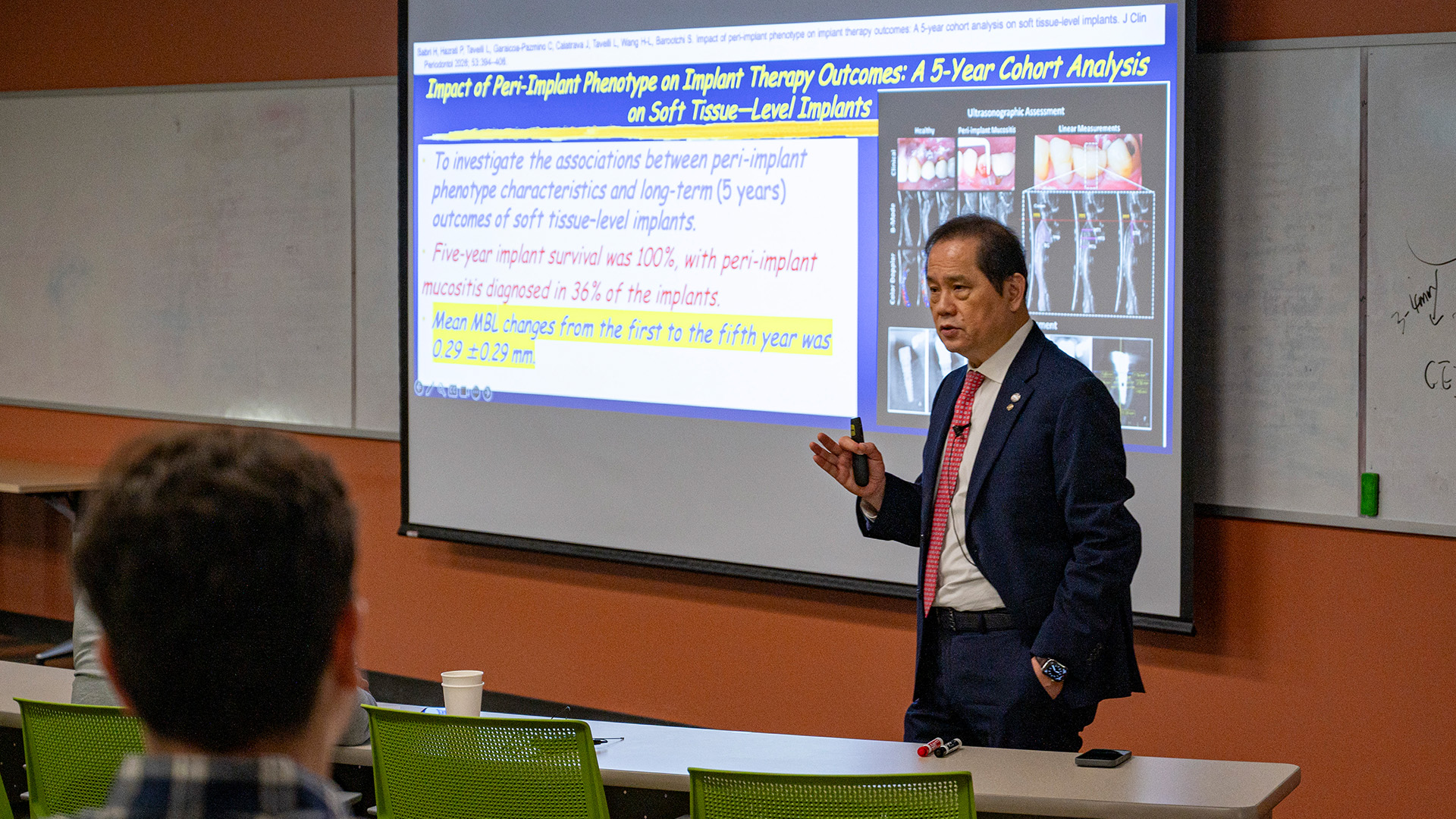
Internationally recognized periodontist and researcher Hom-Lay Wang, DDS, MSD, PhD, presenting at the 10th Annual Innovations in Periodontics Symposium at UTHealth Houston School of Dentistry. Photo by Dylan Allen.
Faculty, residents, students, and practicing dentists gathered June 12 at UTHealth Houston School of Dentistry for the 10th Annual Innovations in Periodontics Symposium, featuring internationally recognized periodontist and researcher Hom-Lay Wang, DDS, MSD, PhD, professor and director of Graduate Periodontics at the University of Michigan School of Dentistry.
Held in the Garza Classroom, the symposium addressed the growing challenge of peri-implant diseases and other complications associated with dental implants.
As part of the symposium, UTHealth Houston School of Dentistry residents from the Advanced Education in Periodontics Class of 2026 presented clinical implant cases for discussion and review. Presenters included Ali Mahamood Al Hatem, DDS; Shahad AlGhanem, DDS; Sara Babban, DDS; and Mary Younan, DDS. The cases highlighted treatment planning, clinical decision-making, and execution of some contemporary site augmentation and implant placement techniques.
During his presentation, Wang reviewed current evidence on the causes, prevention, diagnosis, and treatment of peri-implant complications, emphasizing that many problems can be anticipated and avoided through careful treatment planning and proper implant placement.
“Usually at the time you place the implant, you know potentially whether you’re going to have an issue or not,” Wang said. “You have to determine how to correct and prevent peri-implantitis.”
Wang discussed factors that contribute to implant complications, including implant positioning, soft tissue thickness, prosthetic design, maintenance protocols, and patient-specific risk factors. He stressed the importance of preserving natural teeth whenever possible and viewing implants as a tool to restore function rather than an end goal.
“The goal for a periodontist is not taking the tooth out,” Wang said. “The goal of the periodontist is saving teeth. The implant is a tool to replace a diseased or hopeless tooth, not a healthy one.”
A significant portion of the lecture focused on peri-implantitis, an inflammatory disease that can lead to progressive bone loss around implants. Wang reviewed diagnostic criteria and highlighted emerging research suggesting many implant complications may be linked to surgical and restorative decisions made during treatment planning.
Drawing on decades of clinical experience and research, Wang outlined strategies to reduce complications, including proper implant positioning, maintaining adequate soft tissue thickness, designing restorations that are easy for patients to clean, and establishing long-term maintenance programs.
He also reviewed treatment approaches for peri-implant diseases, including guided bone regeneration, soft tissue grafting, implant surface detoxification, implantoplasty, laser-assisted therapies, and, when necessary, implant removal and replacement.
Throughout the presentation, Wang encouraged attendees to focus on the biological principles underlying implant therapy rather than simply adopting new techniques.
“You want to understand the science,” he said. “If you understand the science, you understand why things work and how to achieve long-term success.”
Wang is one of the world’s leading experts in periodontology and implant dentistry. He has co-edited four textbooks, authored more than 65 book chapters and invited reviews, and published more than 920 peer-reviewed scientific articles. He currently serves on the Board of Trustees of the American Academy of Periodontology and chairs both the Academy of Osseointegration Global Program Development and Education Committee and the AO Credentialing Board Committee.
The symposium was coordinated by Srinivas Ayilavarapu, BDS, DSc, MDS, professor in the Department of Periodontics and Dental Hygiene and program director for Advanced Periodontics at UTHealth Houston School of Dentistry.
The symposium reinforced a central theme of Wang’s presentation: successful implant therapy depends not only on surgical skill, but also on careful planning, sound biological principles, and a long-term commitment to ongoing patient maintenance and care.