

Wong honored with Canadian Forces Medallion for decades of service to military dental surgery
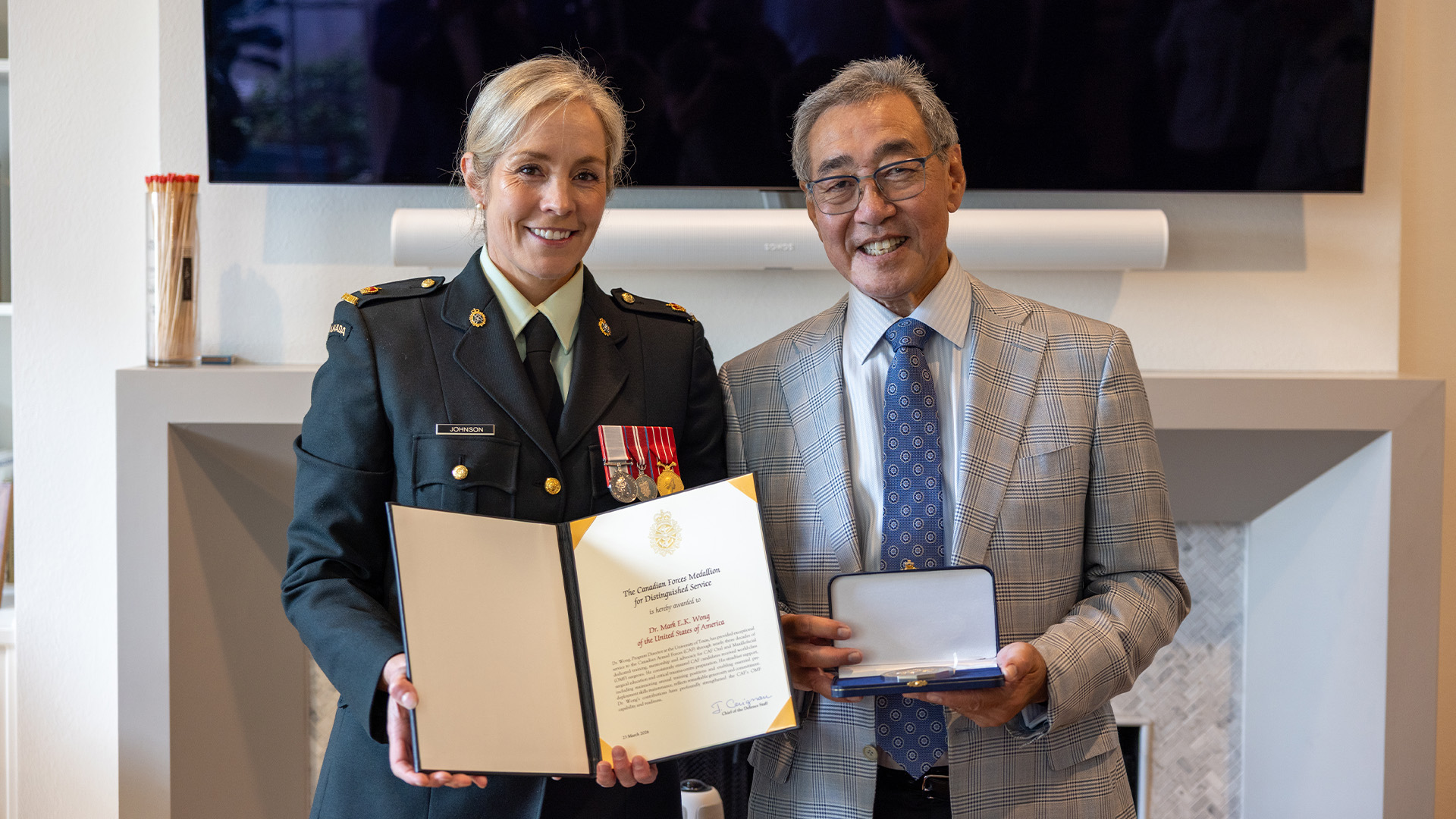
Wong was recognized for nearly 30 years of dedicated training, mentorship, and advocacy on behalf of oral and maxillofacial surgeons in the Canadian Armed Forces. Photo by Seth Gibson/UTHealth Houston Creative Services.
Mark Wong, DDS, professor and chair of the Bernard and Gloria Pepper Katz Department of Oral and Maxillofacial Surgery at UTHealth Houston School of Dentistry, was honored with the Canadian Forces Medallion for Distinguished Service for his decades of service to the Royal Canadian Dental Corps.
Wong was recognized for nearly 30 years of dedicated training, mentorship, and advocacy on behalf of oral and maxillofacial surgeons in the Canadian Armed Forces. His support included training military dental officers, mentoring residents, and helping ensure surgeons maintained critical skills needed for deployment.
Through that work, Wong profoundly strengthened the Canadian Armed Forces’ oral and maxillofacial surgery capabilities and operational readiness, impacting generations of Canadian military surgeons.
The ceremony, held at Wong’s residence, was attended by members of the Canadian Armed Forces oral and maxillofacial surgery training pathway, including current residents and program graduates, along with Wong’s family, friends, and colleagues.
Canadian Armed Forces leaders reflect on Wong’s impact
Senior leaders emphasized that Wong’s influence extended far beyond individual trainees, shaping institutional capability across the Royal Canadian Dental Corps.
“At a strategic level, Dr. Wong’s contributions to the Royal Canadian Dental Corps speak for themselves,” said Lt. Gen. D.E. Molstad, CD, commander of the Canadian Joint Forces Command. “Dr. Wong has strengthened not only individual practitioners, but the institutional competencies that support operations and care for our people.”
Maj. Gen. Scott Malcolm, surgeon general of the Canadian Armed Forces, underscored both the rarity of the honor and the breadth of Wong’s legacy.
“We don’t hand out this award terribly often, but it’s the first time I’ve handed it out,” Malcolm said. “If we’re now going to base the bar for this award on what you’ve accomplished, I’m not sure we’ll be handing it out anytime again soon.”
Malcolm highlighted Wong’s unique commitment to mentorship and advocacy, particularly his role in shaping a highly competitive oral and maxillofacial surgery training pipeline for the Canadian Armed Forces.
“One could argue that you’ve almost single-handedly ensured that the Royal Canadian Dental Corps — and, by extension, the Canadian Armed Forces — have such a robust oral and maxillofacial surgery program within our force,” Malcolm said. “With all that you’ve done, this medallion, while important, really falls short of the impact that you’ve had.”
Oral and maxillofacial surgeons in the Canadian Armed Forces serve a critical role that makes advanced training and readiness essential. As specialized dental officers, they provide comprehensive surgical care that includes battlefield trauma reconstruction, corrective jaw surgery, anesthesia services, and the diagnosis and treatment of complex facial injuries.
Technology helps Wong share his voice
In the months leading up to the ceremony, Wong faced physical challenges that limited his ability to speak. Despite those challenges, he shared his gratitude through a collaboration between two UTHealth Houston schools.
Rather than allowing that limitation to silence his acceptance remarks, colleagues at UTHealth Houston found a way to ensure he could still address those gathered in his honor.
Faculty at the Center for Digital Healthcare Innovation, part of the McWilliams School of Biomedical Informatics at UTHealth Houston, collaborated to digitally recreate Wong’s voice using artificial intelligence and recordings from his past lectures.
Xiaoqian Jiang, PhD, said decades of recorded teaching were central to the project’s success.
“We trained a state-of-the-art voice generation model on many hours of Dr. Wong’s lecture recordings,” Jiang said. “Those lectures were invaluable not only because they were clean and clear, but because they captured him in his element — teaching. That allowed the model to learn far more than the acoustic signature of his voice.”
The project, spearheaded by Jiang and Yuning Xie, MCS, was seen as a reflection of the broader mission of applying emerging technology in the service of people.
“This project is a reminder that the same tools we use to streamline health care workflows can also be turned toward something deeply personal,” Jiang said. “Helping a respected clinician and educator preserve his voice and presence at a moment that mattered.”
Words shaped by a lifetime of service
Through the reconstructed voice, Wong addressed those in attendance, reflecting on the long-standing partnership between UTHealth Houston and the Canadian Armed Forces.
“I am deeply touched and honored to represent the faculty and staff members who are responsible for the training and education of over 25 past and current Canadian Forces residents at UTHealth Houston,” Wong said.
He praised the evolution of that collaboration, which has enabled Canadian Armed Forces oral and maxillofacial surgery trainees to receive advanced, high-volume clinical training in Houston, supplementing their military education with broader exposure to trauma management, orthognathic and reconstructive surgery.
The bidirectional relationship has allowed UTHealth Houston to train skilled military clinicians while strengthening the surgical readiness of the Canadian Armed Forces when those surgeons return to service.
“This very special award is a testimony to this wonderful relationship,” Wong said. “I am very grateful to be the recipient.”
